

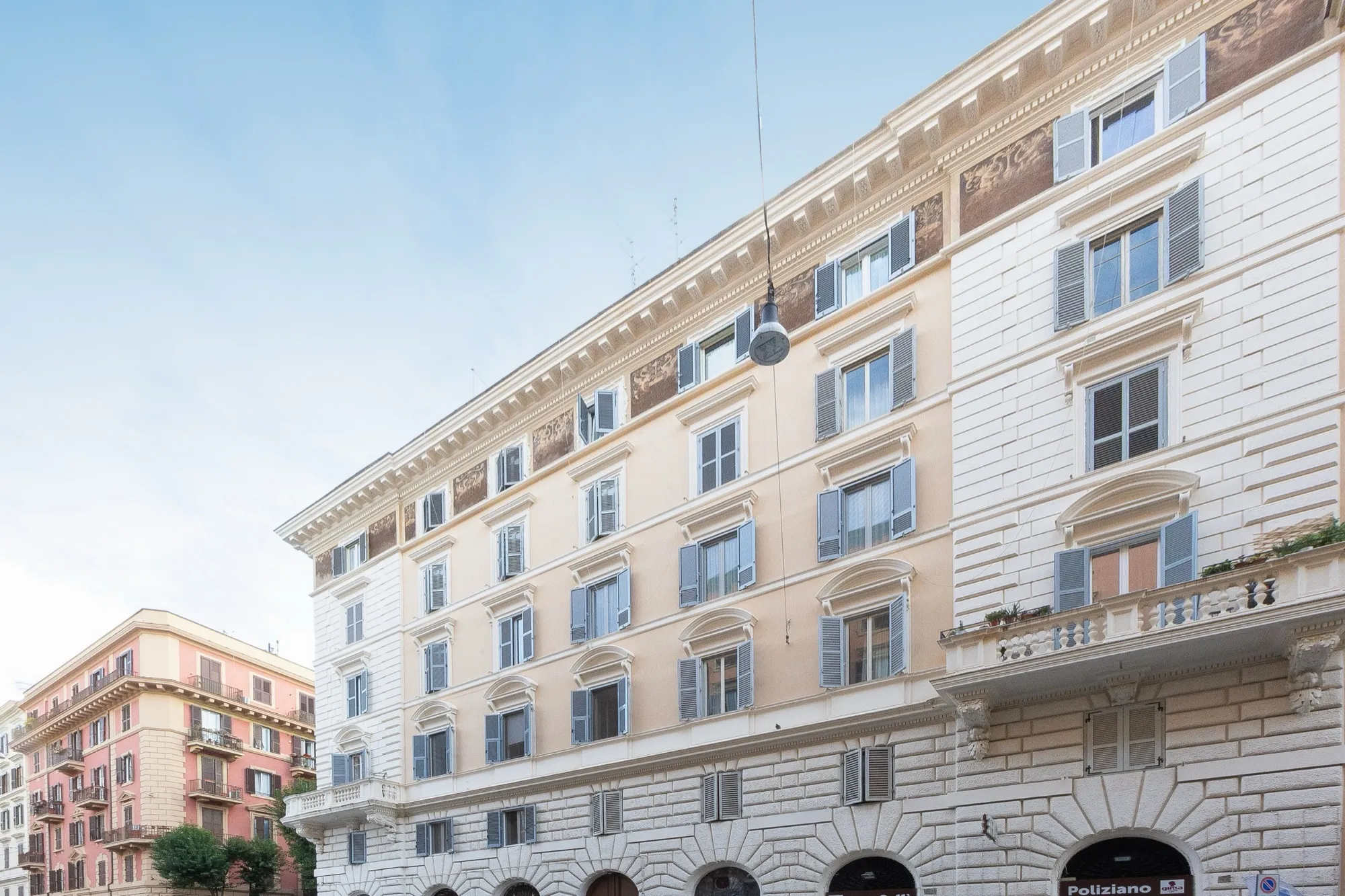
The Celio district, in the heart of Rome, is an authentic journey through centuries of architectural history. It is rich in monuments, historic buildings and archaeological remains that record the evolution of the city from antiquity to the present day — and it is the neighbourhood where our apartments are.
From the origins to the imperial age
Celio takes its name from Mons Caelius, one of the seven hills on which Rome was founded. Already densely inhabited in the Republican era, it reached its peak under the Empire. The area housed the luxurious domus of senators and generals, some still visible in the underground remains of the Basilica of Santi Giovanni e Paolo, with frescoes dating to the third century AD.
The district also held grand public structures: the Castra Peregrina, a barracks for foreign troops, and the Temple of Claudius, an imposing sanctuary built to honour the deified emperor. Traces of both can still be seen, absorbed into later buildings.
The most famous structure at the edge of the Celio is the Colosseum. Not technically part of the district, its effect on the surrounding architecture is undeniable — it shaped the layout of the roads and buildings around it. The Ludus Magnus, the largest gladiatorial training school in Rome, also stood here.
Early Christian and medieval
With the spread of Christianity, the Celio became a major religious centre. Several basilicas were built, among them San Clemente, an architectural masterpiece layered on several levels: a second-century Mithraeum below, a fourth-century church above it, and the upper church from the twelfth century.
Other notable buildings include the Basilica dei Santi Quattro Coronati, with its medieval cloister, and Santo Stefano Rotondo, a rare circular early Christian church. Many of these were raised over older Roman structures, which makes the district a physical record of the city’s transformation from a pagan capital to a Christian one.
Monasteries and fortified ecclesiastical complexes, such as San Gregorio al Celio, played an essential role in the medieval period. Their fortified character reflects the turbulence of the time, with constant conflict between noble families and religious institutions.
Renaissance and Baroque
During the Renaissance and Baroque periods the Celio saw new religious buildings and the renovation of existing ones. The influence of Borromini and Bernini can be felt here too, in elaborate decoration and inventive architectural solutions.
The gardens and villas of this period, such as Villa Celimontana, became retreats for the Roman aristocracy. Built on the site of ancient Roman structures, the villa still holds relics of earlier civilisations within its grounds, including obelisks and sculptures.
Monasteries and hospitals were also established, among them the Hospital of San Giovanni, which still plays a central role in the city’s healthcare today.
From the nineteenth century to now
In the nineteenth and twentieth centuries the Celio underwent significant change. With the unification of Italy and the expansion of Rome, new buildings went up, many for public administration and healthcare. Despite this, the district kept its historic character — its alleys, squares and basilicas.
Barracks and government buildings altered part of its fabric, but most of the ancient and medieval monuments were carefully preserved. The development of archaeological parks and the integration of historic sites into urban planning kept the Celio an essential cultural hub.
Today it is a district where the ancient sits easily with the modern. Its cobbled streets, hidden gardens and views of the Colosseum make it a place to find the real soul of Rome. It also holds cultural institutions, small artisan workshops and traditional trattorias that keep its atmosphere honest. Tram lines and pedestrianised areas have made it more accessible without spoiling it.
What it adds up to
Each era has left its mark on the Celio, creating a mosaic of styles and influences. From imperial residences and military structures to medieval fortifications and Renaissance gardens, it is a neighbourhood where history unfolds at every turn. Walking through it means walking through centuries of architecture — which is, in the end, why we chose to be here.