
Tivoli is the easiest day trip from Rome that feels like leaving the city. The regional train takes about an hour from Roma Tiburtina, and two UNESCO sites wait at the other end: Villa d’Este, a Renaissance garden built around water, and Hadrian’s Villa, the country retreat of a Roman emperor.
You can see both in one day if you start early and visit Hadrian’s Villa first. Below is the route we would follow ourselves, with the hours and prices checked on the official sites on 21 October 2026.
How do you get from Rome to Tivoli by train?
Regional trains on the FL2 line run from Roma Tiburtina to Tivoli station. On the Trenitalia planner, weekday journeys take between 50 and 70 minutes, and a single ticket costs €3. There is roughly one train an hour on weekdays.
Sundays and holidays are thinner. For Sunday 1 November 2026 the planner shows only two morning departures, at 07:10 and 07:15, then nothing until 11:10. Check the times on Trenitalia the evening before, and plan your return train as carefully as the outward one.
From our apartments, Tiburtina is six stops away on metro line B. The nearest entrance is Colosseo station. It is a seven-minute walk from San Giovanni I and San Giovanni II, at Via di San Giovanni in Laterano 84. From Marco Aurelio, at Via Marco Aurelio 43, it is about ten minutes on foot.
Tivoli station sits below the old town, across the river Aniene. The walk up to Piazza Trento, where Villa d’Este has its entrance, takes about fourteen minutes.
How do you get between Villa d’Este and Hadrian’s Villa?
The two villas are about four and a half kilometres apart. Villa d’Este is in the old town, on the hill. Hadrian’s Villa is on the plain below. Walking takes an hour along busy roads, so take the bus.
The local company, CAT, runs line 4 and line 4X from Piazza Garibaldi, a couple of minutes from the Villa d’Este entrance. Its timetable page states that between 08:30 and 19:30 every run of both lines stops at the Hadrian’s Villa site. Buses in the other direction take you back up to the town.
The timetable changes between summer and winter, and some runs operate only on school days. Photograph the timetable at the stop when you arrive.
Which villa should you visit first?
Start with Hadrian’s Villa. It opens at 08:30, it is the larger site, and most of it is outdoors and unshaded. In November and December the last entry is at 15:30, so it makes sense to give it the fresh morning hours.
Villa d’Este suits the afternoon. Its last entry is half an hour later, at 16:00 in November and December. The fountains also look best when the low sun catches the spray.
There is one exception. On Mondays Villa d’Este opens only at 14:00, which makes the order above the only one that works. On a Monday holiday it opens at 08:45 instead, and stays closed until 14:00 the following Tuesday.
What is Hadrian’s Villa, and how long do you need?
Emperor Hadrian built this estate in the second century as a retreat from the court in Rome. It was less a villa than a small city: palaces, baths, libraries, theatres and gardens spread across the countryside below Tivoli.
Two places stay with most visitors. The Canopus is a long pool lined with statues and columns. The Maritime Theatre is a round island house surrounded by its own moat. Both are reached on foot along gravel paths. The official site warns that the route has slopes and uneven ground, so wear proper shoes.
Allow two and a half to three hours. Near the entrance there is a scale model of the whole villa, and it is worth five minutes before you set off. Without it, the ruins are hard to place.
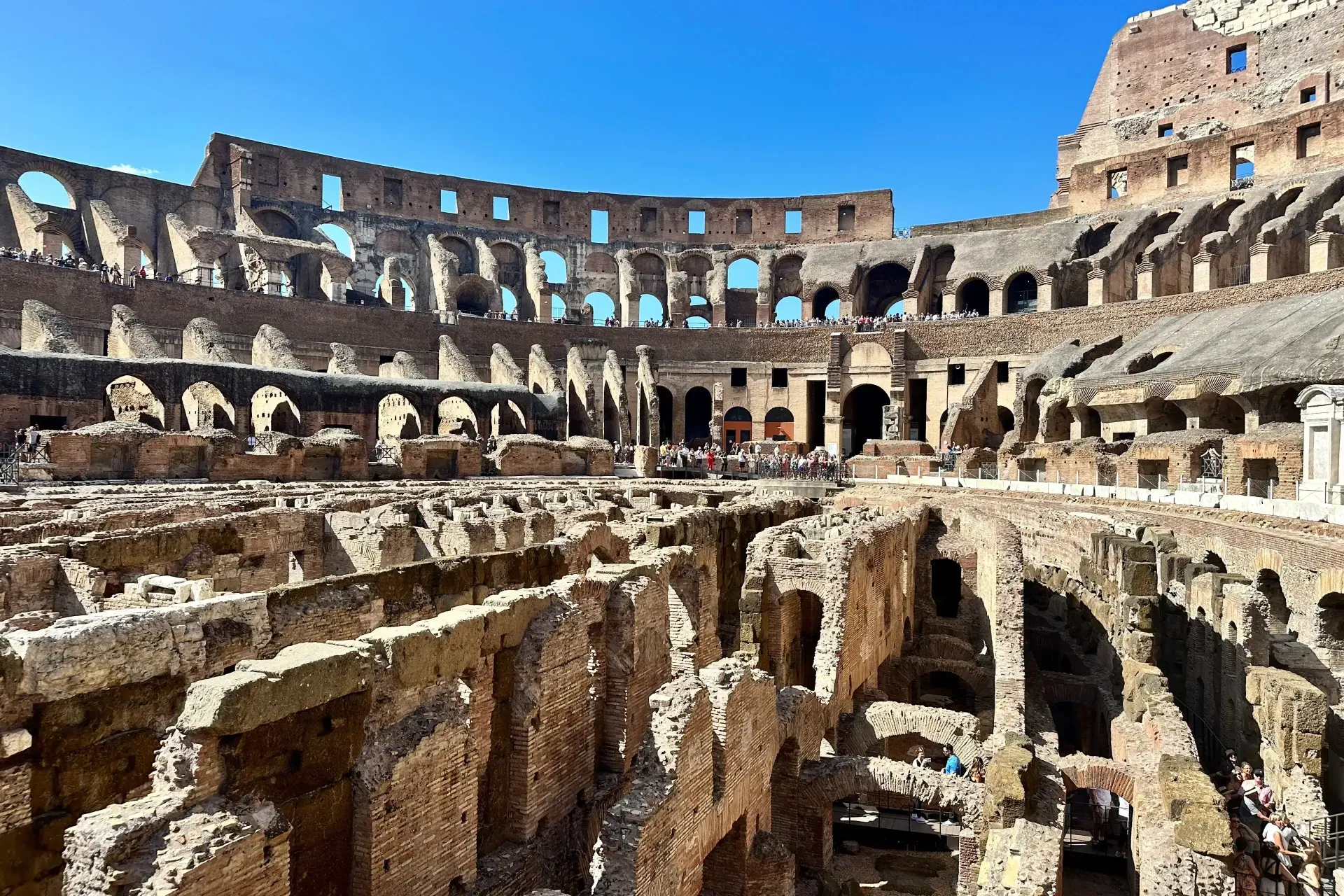
If you have walked the Roman Forum already, you will find the same emperor there: Hadrian also designed the Temple of Venus and Rome, across the road from the Colosseum.
What is Villa d’Este, and when do the fountains play?
Cardinal Ippolito II d’Este turned a former convent into this villa in the sixteenth century. The building is fine, but the reason to come is the garden below it, a steep hillside of terraces, staircases and hundreds of fountains.
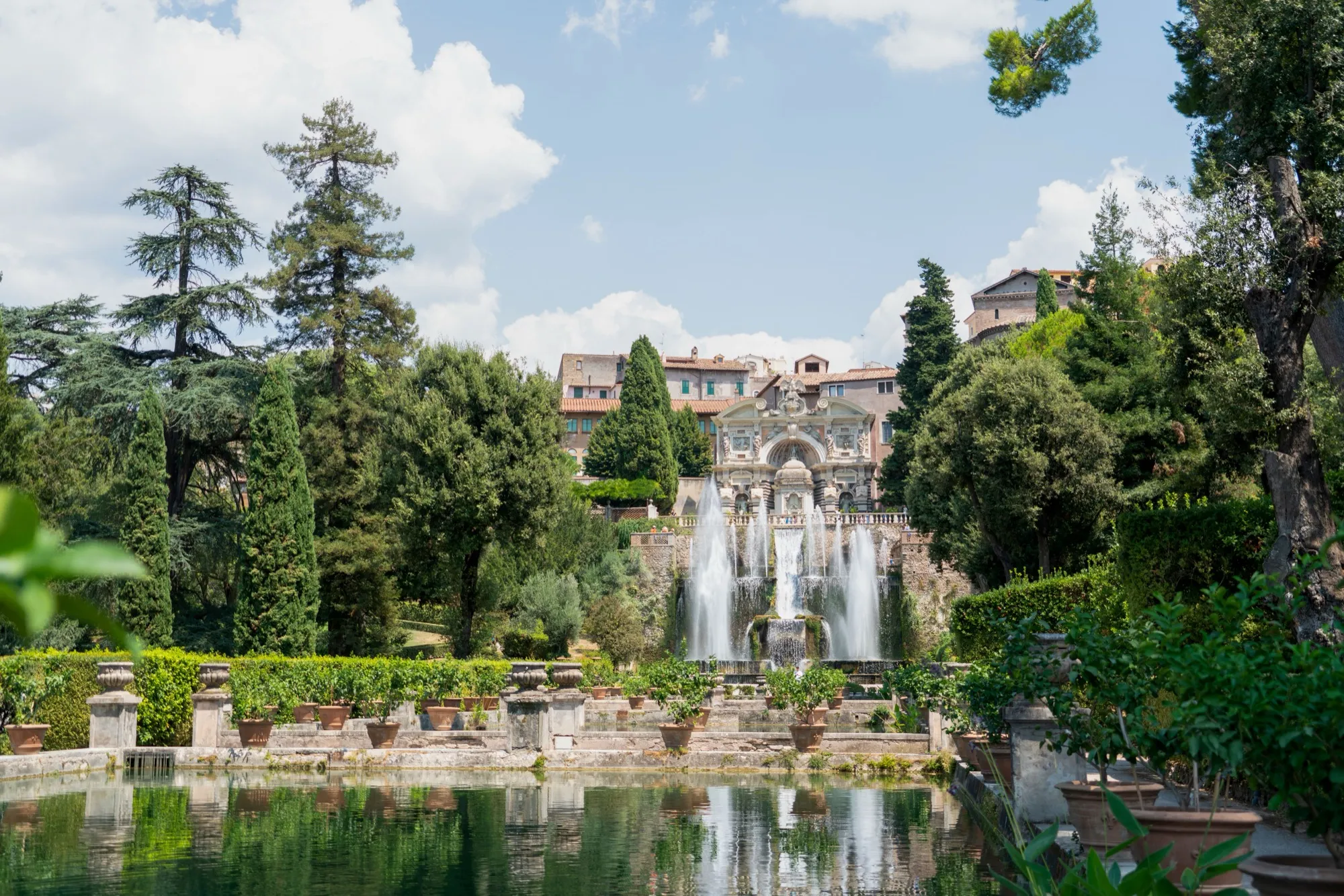
The fountains work without pumps. Water from the Aniene runs downhill through channels and pipes, as it has for more than four centuries. Walk the Avenue of the Hundred Fountains, then go down to the fishponds for the view in our cover photograph.
The Organ Fountain plays music using water pressure alone. According to the official site, it performs every day from 10:30, every two hours. Plan to be in front of it at 14:30 if you arrive after lunch.
After heavy rain, when the Aniene runs high, the water to the fountains can be cut off for a while. The notices on the VILLÆ website are where it is announced. Allow about two hours.
What are the opening hours this autumn and winter?
These are the hours on the official VILLÆ site, checked on 21 October 2026. Both villas close on 1 January and 25 December.
Hadrian’s Villa, open every day:
- From 25 October, after the clocks change: entry 08:30–16:00, exit by 17:30
- November and December: entry 08:30–15:30, exit by 17:00
- January: entry 08:30–15:30, exit by 17:00
Villa d’Este, open every day, Mondays from 14:00:
- From 25 October, after the clocks change: entry 08:30–16:30, exit by 17:30
- November and December: entry 08:30–16:00, exit by 17:00
- January: entry 08:30–16:00, exit by 17:00
How much are tickets, and do you need to book?
On the official ticket office, villae.midaticket.com, a full ticket for Hadrian’s Villa costs €15. The Ministry of Culture lists the same price for Villa d’Este. EU citizens aged 18 to 25 pay €2.
If you are seeing both, the VILLÆ Pass costs €30. It covers Hadrian’s Villa, Villa d’Este and the Sanctuary of Hercules Victor for 72 hours from the first entry. It saves nothing on the two villas alone, but it saves a queue.
Booking is optional for individual visitors. Entry is free on the first Sunday of every month and on 4 November. On free days tickets cannot be booked at all: you collect them at the ticket office, so expect a queue.
Where can you have lunch in Tivoli?
Between the two villas, you will want a proper sit-down lunch. Our suggestion is Sibilla, at Via della Sibilla 42, a restaurant beside two Roman temples on the edge of the gorge.
Its terrace looks over the waterfalls of Villa Gregoriana. It is open Tuesday to Sunday for lunch, from 12:30 to 15:00, and it is about nine minutes on foot from Piazza Trento. Book through its website, especially at weekends.
Is there anything else worth seeing in Tivoli?
If you have energy left, Villa Gregoriana is a wooded park in the Aniene gorge, run by the FAI, the Italian National Trust. Paths lead down to the great waterfall and back up again. The FAI warns of many slopes and steps, so it is not for pushchairs.
It is open every day. According to the FAI calendar, the hours are 09:30–16:30 in November, with last entry at 15:30. The calendar lists no opening days between 21 December and 13 February. A full ticket costs €10. It is a fourteen-minute walk from the train station, so it also works as a short visit before the train home.
Common questions
Can you do Tivoli in half a day? Only one villa. Choose Villa d’Este if you want gardens and water, Hadrian’s Villa if you prefer ancient Rome. Both villas in one trip need a full day.
Is Tivoli worth it in winter? Yes, with shorter hours. The gardens are green all year and much quieter than in spring. Check the weather: after heavy rain, the fountains may be switched off.
Is there a ticket that covers both villas? The VILLÆ Pass, at €30, covers both villas and the Sanctuary of Hercules Victor for 72 hours. Individual tickets are €15 each.
Can we go by car instead? You can, but parking near Villa d’Este is limited. If you would rather not drive, our chauffeur service can take you to Tivoli, wait while you visit and bring you back.
What should we wear? Comfortable shoes with grip. Hadrian’s Villa is mostly gravel and grass, and Villa d’Este is built on a slope with many steps, some of them wet.
Before you go
Tivoli rewards an early start. Take the first sensible train, see Hadrian’s Villa in the morning light and keep the fountains for the afternoon. You will be back in Rome in time for dinner.
For the rest of your days in Rome, our guide to things to do near the Colosseum covers the neighbourhood around our apartments.