

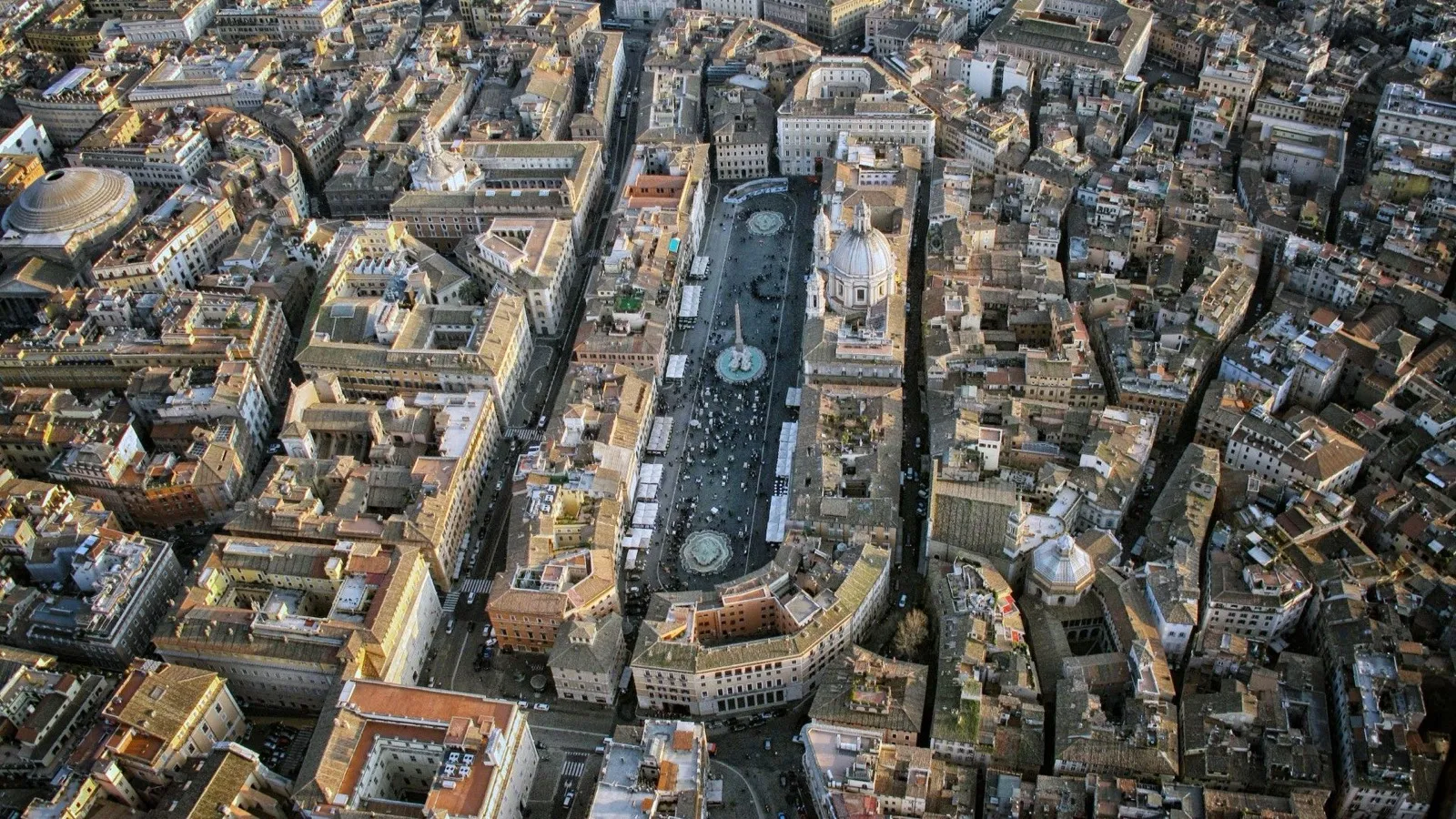
Rome is a city best experienced on foot, which means where you sleep determines what you see, smell and feel before you have had your first espresso. Stay in the wrong neighbourhood and you will spend your trip on buses and taxis. Stay in the right one, and the city unfolds around you.
This guide covers the six neighbourhoods we consider the best bases for visiting Rome — from the ancient Celio hill above the Colosseum to the streets of Trastevere and the boulevards of Prati. We are honest about the trade-offs of each, and about who each one suits.
| Neighbourhood | Best for | Character | Price | To the Colosseum |
|---|---|---|---|---|
| Celio | History, peace and quiet | Ancient, serene | €€ | 5 min |
| Monti | Style-conscious travellers | Bohemian, busy | €€€ | 10 min |
| Trastevere | Romantics and food lovers | Lively, atmospheric | €€ | 30 min |
| Centro Storico | First-time visitors | Iconic, central | €€€€ | 25 min |
| Prati | Families, Vatican visitors | Elegant, residential | €€€ | 35 min |
| Testaccio | Food obsessives | Authentic, unpretentious | €€ | 20 min |
Celio
The ancient hill, steps from the Colosseum
The Celio is Rome’s best-kept secret. This ancient hill, rising just south of the Colosseum and east of the Circus Maximus, is one of the city’s original seven — and yet it remains almost entirely off the tourist radar. While visitors swarm around the Colosseum and then disappear back to their hotels in the centro storico, the Celio stays quiet, green and genuinely Roman.
Staying here means waking up five minutes’ walk from one of the most extraordinary views in the world. The neighbourhood is dotted with early Christian churches, hidden gardens, medieval towers and small trattorias where the owner knows every regular by name. It is, in our view, the single best base in Rome for a visitor who wants to experience the city rather than tick off its sights.
Our apartments are in the heart of the Celio, which is why we know this neighbourhood better than anyone. This is not just an area we recommend. It is home.
Our tip. Set an alarm for half past six on your first morning and walk to the Colosseum before the crowds arrive. The light is extraordinary, there are almost no tourists, and you will have one of the great Roman experiences to yourself. There is no better start to a day in Rome.
What you’ll find here: the Colosseum, Roman Forum and Palatine Hill within ten minutes on foot · Villa Celimontana, a beautiful and rarely visited park · Santo Stefano Rotondo, one of Rome’s oldest and most haunting churches · Santi Giovanni e Paolo, a fourth-century basilica built over a Roman house · Li Rioni, one of Rome’s best pizzerias · and real quiet after seven in the evening.
Worth weighing: fewer restaurants than Trastevere or Monti, slightly hilly streets, and a quieter nightlife — which is the point for some and a drawback for others.
Monti
A village between the Colosseum and Termini
Monti is the neighbourhood Romans move to when they want to feel they are living in a village, and that visitors discover when they want to feel Roman. Wedged between the Colosseum and Termini station, it occupies the ancient Subura — Rome’s most notorious working-class district in antiquity — and has reinvented itself as the city’s most characterful, liveable quarter.
The streets are narrow and photogenic, lined with independent boutiques, wine bars, good restaurants and small churches. The social hub is Piazza della Madonna dei Monti, where locals gather for aperitivo every evening.
Our tip. Join the aperitivo crowd at Piazza della Madonna dei Monti around half past six. Buy a Negroni from one of the bars on the square, find a spot on the steps of the fountain, and watch the neighbourhood come alive. One of the great free shows in Rome.
What you’ll find here: the best aperitivo square in Rome · Trattoria Monti, one of our top recommendations · vintage and independent shopping on Via del Boschetto · ten minutes on foot to the Colosseum · the Basilica of Santa Maria Maggiore.
Worth weighing: accommodation costs more than in the Celio or Testaccio, and the square gets busy on weekend evenings.
Trastevere
The west bank, and the city’s most photographed streets
No neighbourhood in Rome is more photographed than Trastevere, and for good reason. The labyrinth of golden-ochre buildings, ivy-clad walls and uneven cobblestones on the west bank of the Tiber is stubbornly beautiful. In the evenings, when the light turns amber and the restaurants fill with conversation, it is one of the most atmospheric places in Europe.
It is also home to two of Rome’s finest trattorias — Da Enzo al 29 and Trattoria Da Teo — and to the Basilica of Santa Maria in Trastevere, one of the oldest churches in the city. It has become steadily more popular over the past decade, which means it can feel less local than it once did, particularly on summer evenings.
Our tip. The best of Trastevere is in its quieter northern section, around Via dell’Arco di San Calisto and Piazza dei Ponziani, away from the main circuit. This is where Romans still live, and where the aperitivo bars are honest.
What you’ll find here: the most romantic streetscapes in Rome · Santa Maria in Trastevere · the Porta Portese flea market on Sunday mornings · Villa Farnesina and its Renaissance frescoes.
Worth weighing: thirty minutes on foot from the Colosseum, no direct metro, and the main square can be noisy at night.
Centro Storico
The heart of Renaissance Rome
The historic centre — bounded by the Tiber to the west and the Roman Forum to the east — is where first-time visitors instinctively want to stay, and the logic is sound. The Pantheon, Piazza Navona, Campo de’ Fiori and the Trevi Fountain are all within a fifteen-minute walk. You can step out of your door and be standing in front of a Caravaggio within minutes.
The trade-off is price and density. This is the most expensive place to stay in Rome, and in peak season the streets around the main monuments can feel genuinely overwhelmed.
Our tip. The centro storico transforms during the day. At seven in the morning it is quiet, beautiful and almost entirely yours. By eleven the crowds arrive and the atmosphere changes completely. Stay here and you will quickly learn to live by Roman hours.
What you’ll find here: the Pantheon, free to enter and overwhelming in its perfection · Piazza Navona, best at night · Campo de’ Fiori and its daily market · the Trevi Fountain at dawn, when it is almost empty · Armando al Pantheon.
Worth weighing: the highest prices in the city, heavy crowds in season, and restaurants that cater largely to visitors.
Prati
Wide boulevards, near the Vatican
Prati sits immediately north of Castel Sant’Angelo, on the right bank of the Tiber. It was built in the late nineteenth century as a prosperous residential district, and still feels like one: wide tree-lined boulevards, excellent food shops, a neighbourhood market, and a pace distinctly calmer than the centro storico.
Its great advantage is the Vatican. St Peter’s and the Vatican Museums are ten to fifteen minutes on foot, which makes Prati the obvious base for visitors whose priority is the world’s greatest art collection.
Our tip. Book Vatican Museums tickets months ahead — they sell out. From Prati you can take the eight o’clock entry slot, walk there in fifteen minutes through quiet streets, and see the Sistine Chapel before it fills.
What you’ll find here: St Peter’s Basilica · Castel Sant’Angelo · Via Cola di Rienzo, Rome’s best street for food shopping · the Tiber walk into the centre · and a genuinely residential feel that suits families.
Worth weighing: thirty-five minutes on foot from the Colosseum, and fewer independent restaurants than Trastevere or Monti.
Testaccio
Where Roman cooking was invented
Testaccio is Rome’s most authentically working-class neighbourhood and, for many food lovers, the most important place in the city. Built around Monte Testaccio — a hill made entirely of broken Roman amphorae — and the site of the city’s historic slaughterhouse, it gave birth to the cucina romana: the nose-to-tail tradition that produced cacio e pepe, carbonara, coda alla vaccinara and the other dishes that now define Italian food worldwide.
Today it holds one of Rome’s best food markets, a cluster of outstanding restaurants including Felice a Testaccio, and a neighbourhood feel refreshingly free of tourist infrastructure.
Our tip. Go to the Mercato Testaccio on a weekday morning. It is one of Rome’s finest — a covered market full of outstanding produce and vendors who will hand you a sample before you have asked. Arrive by nine for the best of it.
What you’ll find here: Felice a Testaccio, home of Rome’s finest cacio e pepe · the Mercato Testaccio · Monte Testaccio · the Non-Catholic Cemetery, where Keats and Shelley are buried · the Aventine and its Knights of Malta keyhole, fifteen minutes away.
Worth weighing: twenty minutes on foot from the Colosseum, and less immediately pretty than Trastevere or Monti.
Questions we are asked most
Which neighbourhood is best for a first visit?
Either the Celio, if the Colosseum and ancient Rome are your priority, or the Centro Storico, if you want to be in the absolute heart of everything. The Celio offers better value, more quiet and an extraordinary location near the ancient monuments. The Centro Storico puts the Pantheon and Piazza Navona on your doorstep.
Are all these neighbourhoods safe?
Rome is generally a very safe city for visitors, and all six are safe, including at night. The usual urban precautions apply: be aware of pickpockets in crowded places like the Colosseum and the Trevi Fountain, and keep an eye on your bag on public transport. The Celio, Prati and Testaccio are particularly calm.
Do I need a car?
No, and we would actively discourage it. The historic centre has extensive restricted traffic zones, parking is scarce and expensive, and the city is best seen on foot. All six neighbourhoods are well connected by metro, tram and bus.
Which is best for families with children?
Prati, for the wider streets, lower noise and excellent supermarkets. The Celio is also very good: Villa Celimontana is a beautiful green space, and the proximity to the Colosseum makes for genuinely magical family mornings.
How far ahead should I book?
For peak season — April to June, and September to October — two to three months ahead, particularly for well-located apartments in the Celio, Monti and Trastevere. March and April fill early because of Easter.
Walking times are approximate.